Erasmus+ accreditation

Our Erasmus+ approach

One accreditation, four objectives, four priorities, three charters and a steering team: the “Mobility Leborgne 2027” method.

Erasmus+ accreditation

Accredited school since 2022

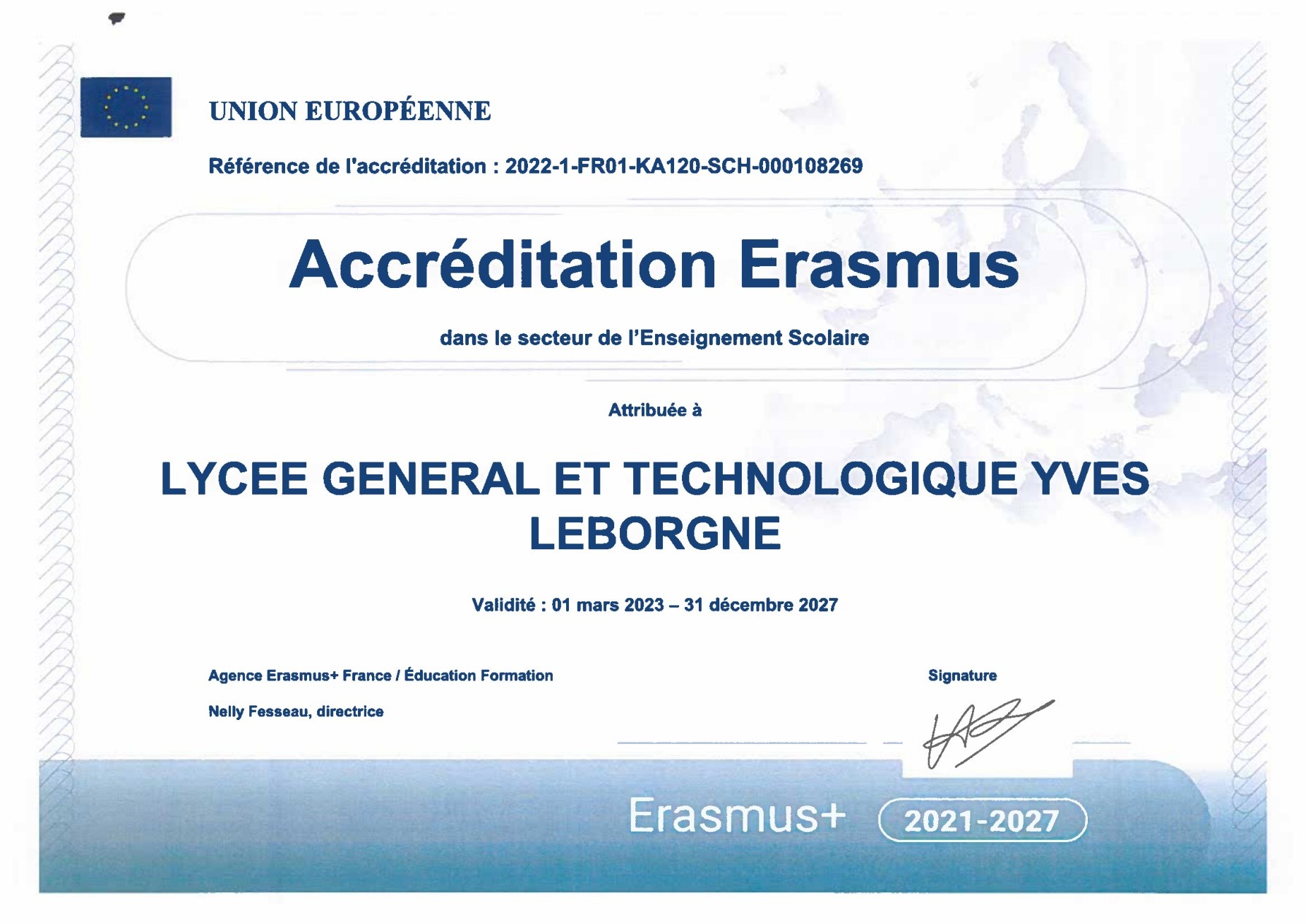
Since 2022, Lycée Yves Leborgne holds an Erasmus+ accreditation in the school education sector, valid from 1 March 2023 to 31 December 2027. This accreditation, awarded by the Erasmus+ France / Education & Training Agency under reference 2022-1-FR00-KA120-SCH-000108269, funds student and staff mobilities every year and commits the school for the long term.

Accreditation reference
2022-1-FR00-KA120-SCH-000108269
Validity
1 March 2023 to 31 December 2027
Erasmus+ France / Education & Training Agency
Nelly Fesseau, Director
Erasmus+ OID identifier
E10088840
Erasmus+ accreditation certificate

Our four objectives

  1. 1

    Develop students’ transversal and psycho-social skills to support their integration

  2. 2

    Develop our students’ local social participation and give meaning to their European citizenship

  3. 3

    Enable staff upskilling and adapt teaching practices to the challenges of our society

  4. 4

    Embed eco-gestures, inclusive and caring practices into our everyday behaviour

The four priorities of the Erasmus+ programme

  • Inclusion
  • Education for sustainable development
  • Education to responsible digital use
  • Democratic participation

Our Erasmus+ plan in three stages

  1. 2022 – 2025

    Consolidate our European openness actions, train staff in physical and virtual mobility, and make student mobility in Europe possible.

  2. 2025 – 2027

    Encourage staff to join or build mobility and partnership projects (KA1 / KA2) towards Europe and the Caribbean region.

  3. 2027 →

    Offer every volunteer student and staff member a physical or virtual mobility experience during their time at the school, and radiate across the academy district by becoming a consortium, led by the City of Sainte-Anne.

A proven yearly method

Each school year follows the same proven ritual: monthly meetings of the steering team, launch of the project workshops in October, hybrid preparation with partners, parents’ information meetings before each mobility, charters signed by each volunteer, pedagogical continuity organised during the stays, individual and school assessments, then dissemination during the Erasmus Days and the Mobility Forum.

2025-2027: scaling up

For the 2025-2026 school year, the project has a budget of €112,555 serving 63 mobilities and 5 hostings: 3 group mobilities of 9 or 6 days to 3 European countries for 53 students and 6 accompanying staff, 4 staff observation mobilities, 2 long individual student mobilities of 5 weeks, and 5 hostings of staff or groups from the partner schools: Iceland, Denmark Vedersø, Denmark Ranum, Italy Milan and Boston.

In 2027, at the end of the accreditation, the school will apply to the next campaign in a consortium led by the town hall of Sainte-Anne: the ambition to offer a physical or virtual mobility experience to every voluntary student and staff member during their path at the school, and to radiate across the academic district.
Three charters framing every mobility

Inclusion charter for participants

It guides the selection of participants with inclusive objectives: grant-holding students, geographical distance (outermost regions) or digital divide, special educational needs, school drop-out risk, commitment to the school community, to the hybrid process (eTwinning/ESEP), to interdisciplinarity, to preparation and to dissemination.

Sustainable development charter

Eleven eco-responsible commitments: limiting greenhouse-gas emissions by favouring low-carbon transport, local food, energy and water savings, waste reduction and sorting, protection of biodiversity, clean-up and replanting actions, embedding ESD in every subject.

Responsible digital charter

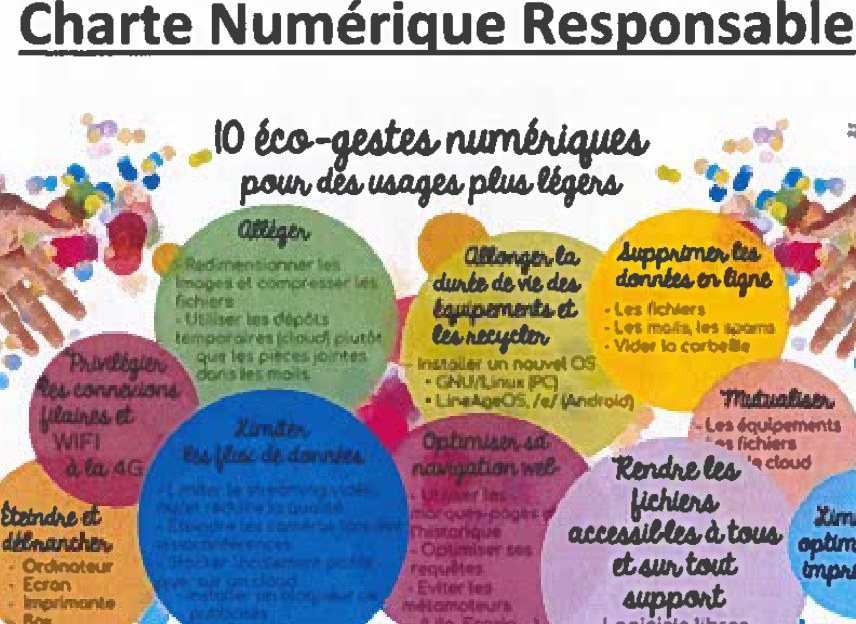
Ten digital eco-gestures: extending equipment lifespan, switching off and unplugging, limiting data flows, favouring wired and Wi-Fi connections, making files accessible, sharing resources, deleting online data, optimising printing, lightening files and web browsing.

Responsible digital charter: the 10 gestures

  1. Extending the life of equipment and recycling it
  2. Switching off and unplugging equipment when not in use
  3. Limiting data flows: reduced streaming, cameras off in video conferences, local storage, ad blocker, free software
  4. Preferring wired connections and WiFi over 4G
  5. Making files accessible to all and on any device: free software, PDF format, suitable font
  6. Sharing: shared connection, common printer, lending of equipment
  7. Deleting online data, and thinking before sending videos, photos or emails
  8. Limiting and optimising printing: double-sided, several pages per sheet, economical font
  9. Lightening: resizing images, compressing files, temporary deposits rather than attachments
  10. Optimising web browsing: bookmarks, history, avoiding metamotors

Sustainable development charter: the 11 commitments

  1. Limiting greenhouse gas emissions: public, low-carbon transport, travelling light
  2. Preferring local and organic food
  3. Taking part in energy savings: limited air conditioning and heating, unplugged devices, lights off
  4. Saving water
  5. Not consuming unnecessarily: every purchase must be useful and durable
  6. Reducing the amount of waste produced: non over-packaged products
  7. Taking part in selective sorting and the circular economy: compost, swapping
  8. Knowing, respecting and protecting local biodiversity
  9. Making our environment cleaner: waste collection, replanting
  10. Raising awareness of daily eco-responsible gestures: articles, posters, slogans, contests
  11. Embedding sustainable development education in all subjects and promoting environmental careers
Responsible digital charter of the school
Responsible digital charter: 10 digital eco-gestures for lighter uses.