Every mobility of LGT Yves Leborgne leaves traces: films, cultural sheets, posters — and logbooks written in the first person. Those of spring 2026, written by Camille Gréfine in Denmark and by Loane Siarras and Adon Kiliane in Andalusia, form a collective ship’s log in which the groups can be followed hour by hour.
In Denmark (20 to 29 March 2026), Camille discovers Billund and its Lego dinosaur, the six meals a day of the efterskole, tumbling which became her favourite sport, the Moesgaard Museum and the city of Aarhus, a history lesson on the Second World War taught in English, a farm where fresh milk is tasted, and cinnamon rolls baked in a cooking class.
The Danish week ends between the wind-beaten Blåvandshuk lighthouse, the FLUGT museum of Oksbøl dedicated to refugees — “by far the best museum” of the stay, she writes —, the Tirpitz bunker in Blåvand, then a Parisian stopover: hostel, Nation district, La Défense by RER and the Cluny museum.
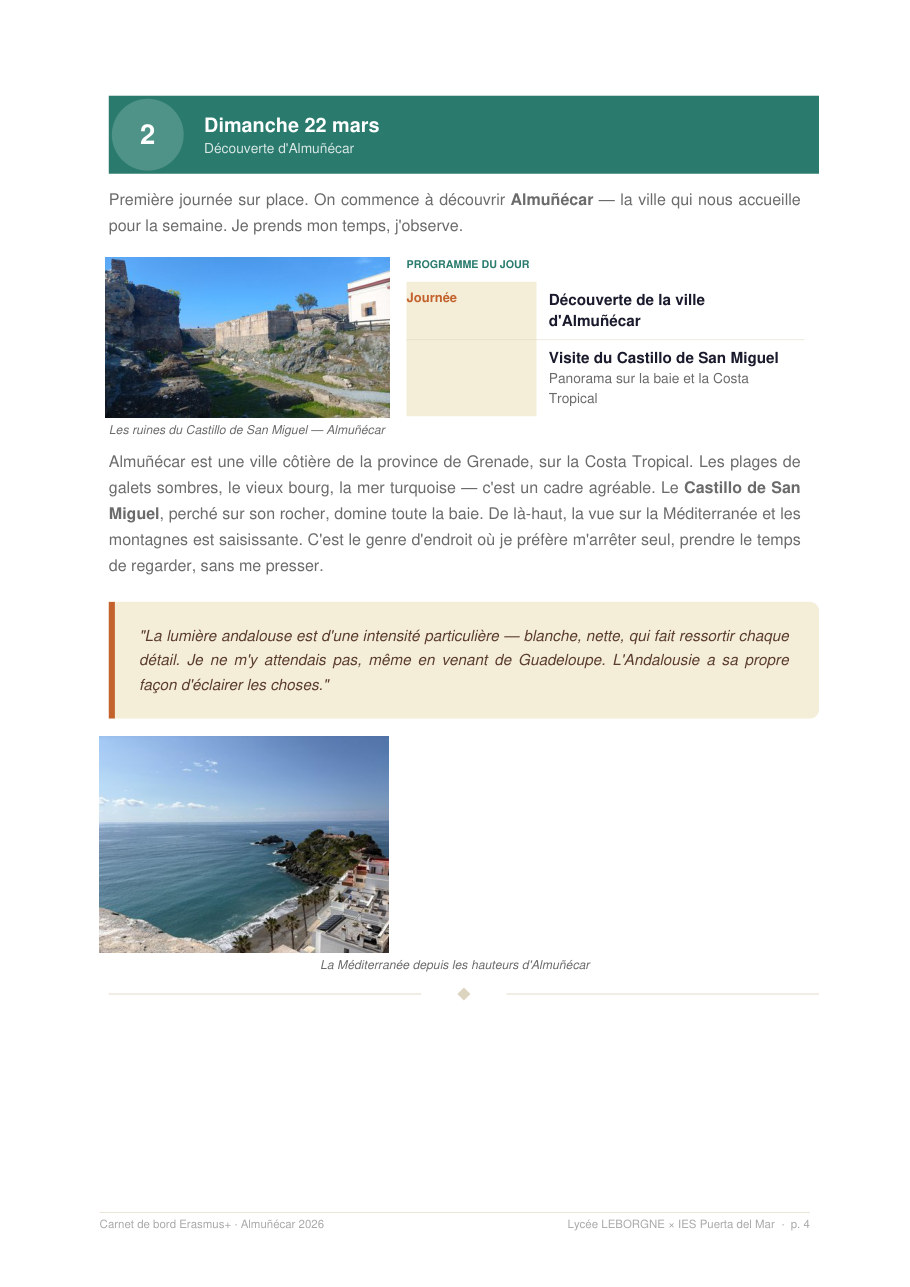
In Andalusia (21 to 27 March 2026), Loane and Adon Kiliane tell the arrival at the Almuñécar hotel, the guided visit of the town by their Spanish teacher, the Ron Montero rum distillery in Motril, the hospitality school and its juices pressed by the students, the days in host families, the treasure hunt across the town and the day of 24 March in Granada: Nasrid palaces, Generalife gardens and UNESCO World Heritage.
Two writings, two temperaments: Camille’s enthusiastic logbook, Adon Kiliane’s measured gaze — “I am not someone who talks a lot, but this experience deserves to be written”. These logbooks, preserved in the site gallery, document mobility as it is lived: a school of observation, mutual help and trust.
Adon Kiliane’s logbook also follows the visit of IES Puerta del Mar, the presentation of the project to the Andalusian school community and the farewells of 27 March and the departure of 28 March; Camille’s details the shared classes, the leaving party and the certificate ceremony of 27 March.